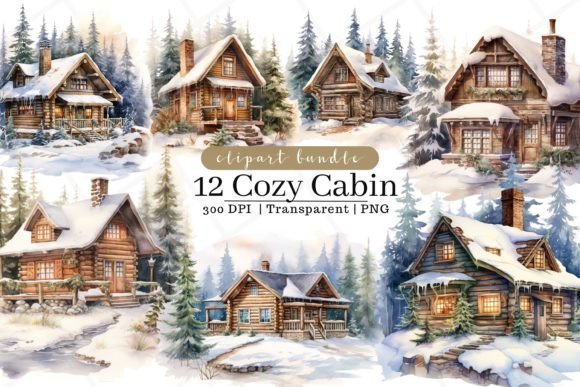
Winter Cozy Cabin Illustrations for Client Design
When evaluating a new graphic design asset for a professional client project, my first criterion is always emotional resonance. Technical specs matter, but if an illustration does not immediately evoke the intended feeling, it fails as a communication tool. Upon reviewing the Winter Cozy Cabin Watercolor Clipart collection, the immediate impression is one of nostalgic warmth and tactile authenticity. This is not a sterile, vector-based icon set; it possesses the organic bleeding edges and pigment variation characteristic of traditional media. For a designer tasked with building a visual identity for a handmade business, a seasonal marketing campaign, or a boutique hospitality brand, this asset communicates "comfort" before the viewer even reads the headline.
In a recent concept phase for a small business branding project focused on sustainable winter goods, I needed visuals that bridged the gap between rustic tradition and modern design sensibilities. The Winter Cozy Cabin Watercolor Clipart succeeded because it avoids cartoonish exaggeration. Instead, it offers a grounded, painterly aesthetic that feels curated rather than generic. This distinction is vital when targeting an audience that values craftsmanship and authenticity over mass-produced perfection.
Elevating Brand Identity and Packaging Concepts
For brand identity work, specifically within the lifestyle and home goods sectors, these illustrations serve as excellent supporting elements. While I would rarely recommend using detailed watercolor clipart as a primary logo mark due to scalability issues, they are exceptional for secondary brand assets. Imagine a coffee roaster’s winter blend packaging: the cabin illustration acts as a focal point on the label, establishing a premium, artisanal tone that flat graphics cannot achieve. In packaging design, this level of textural detail suggests quality and care, directly influencing perceived value.
The collection also performs strongly in editorial design and web design contexts. When laying out a blog post about hygge living or a landing page for a retreat center, these illustrations break up dense text blocks without feeling jarring. They provide visual breathing room that aligns with the content's narrative. Unlike stock photography, which can sometimes feel impersonal, watercolor illustrations invite the viewer into a story. For Etsy product listings or print-on-demand sellers, incorporating these elements into listing images or thank-you cards creates a cohesive unboxing experience that encourages customer loyalty and social sharing.
Strategic Applications Across Digital and Print Media
Versatility is key when investing in a design bundle. Through practical testing, I found the Winter Cozy Cabin Watercolor Clipart adapts well to various mediums, provided the designer respects the medium's constraints:
- Social Media Graphics: These assets shine in Instagram carousels and Pinterest pins where vertical space allows for detail. They add a human touch to promotional quotes or sale announcements.
- Printable Design: For wall art or planner stickers, the watercolor texture translates beautifully to paper. The soft edges blend naturally with matte cardstock, avoiding the harsh digital look of standard PNG designs.
- Sublimation Design: On items like mugs and tote bags, the organic color gradients create a vintage, heirloom quality. However, designers must account for fabric absorption during the heat press process.
- Cricut Project Work: While primarily raster art, high-resolution versions work for print-then-cut features. For pure vinyl cutting, users should verify if SVG design files are included or if manual tracing is required.
- Canva Template Creation: As decorative accents in templates sold on creative marketplace platforms, these illustrations add significant perceived value compared to free library elements.
Navigating Visual Hierarchy and Layout Constraints
Despite its charm, this asset requires disciplined application. Watercolor is inherently busy; the varying opacity and splatter details compete for attention. In my review, I noted that these illustrations struggle in crowded layouts or complex backgrounds. If your design already features heavy typography, multiple photos, and textured overlays, adding a detailed cabin scene will degrade readability. Visual hierarchy suffers when every element screams for attention.
I advise against using this clipart for minimalist corporate branding or tech-forward companies. The style is too emotive and traditional for industries requiring sleek, futuristic, or ultra-clean aesthetics. Furthermore, small-scale applications pose a risk. At favicon size or on a business card footer, the delicate brushwork turns into visual noise. These illustrations demand negative space to breathe. They function best as hero graphics, large background textures with reduced opacity, or isolated focal points surrounded by ample whitespace. Always prioritize legibility and brand consistency over decoration.
Essential Pre-Flight Checks for Commercial Use
Before integrating Winter Cozy Cabin Watercolor Clipart into any commercial design workflow, rigorous technical validation is non-negotiable. Professionalism lies in the details that clients never see but always feel.
- Contrast Testing: Never assume the asset works on all backgrounds. Test the PNG design on both pure white and deep charcoal. Watercolors often lose definition on mid-tone backgrounds. You may need to add a subtle drop shadow or outer glow to maintain separation.
- Typography Pairing: The organic nature of watercolor demands thoughtful font selection. A rigid geometric sans serif can create a striking modern contrast, while a flowing script enhances the romantic mood. Avoid overly distressed fonts, as they compete with the illustration's natural texture.
- Resolution Verification: For t-shirt design or large format printing, ensure the file resolution exceeds 300 DPI at the intended print size. Upscaling raster art results in pixelation that destroys the watercolor illusion.
- Transparency Inspection: Check the alpha channel. Poorly extracted clipart often retains white halos or jagged edges. Clean masking is essential for seamless integration into colored layouts.
- Licensing Confirmation: Always review the commercial license terms. Verify if the asset can be used in end products for sale, such as digital planners or physical merchandise, versus personal use only. Protecting your client from copyright infringement is part of our ethical duty.
Assessing Emotional Impact and Market Viability
Ultimately, the decision to use Winter Cozy Cabin Watercolor Clipart hinges on the desired emotional outcome. Does the client need to convey safety, tradition, and warmth? If so, this asset is a powerful vehicle. It triggers sensory associations—woodsmoke, wool blankets, quiet snowfall—that text alone cannot replicate. In a saturated market, emotional connection drives conversion. Whether designing a holiday greeting card line or rebranding a local bakery, these illustrations offer a shortcut to intimacy.
However, designers must remain objective. An asset is only as good as its execution. By treating this clipart as a sophisticated component of a larger system rather than a standalone fix, we elevate it from mere decoration to strategic communication. When balanced correctly with strong typography, intentional whitespace, and verified technical quality, Winter Cozy Cabin Watercolor Clipart transforms standard deliverables into memorable brand experiences. It is a worthy addition to the toolkit of any creative professional serving clients who value the enduring appeal of handcrafted aesthetics in a digital world.